

Can you publish a Wikipedia page? — Confident & Powerful Guide
- The Social Success Hub

- Nov 14, 2025
- 10 min read
1. 5–10 independent, reliable sources are often enough to establish a solid case for a Wikipedia page. 2. A well-sourced draft typically stabilizes in weeks; under-sourced drafts can be removed within days. 3. Social Success Hub has a proven authority-building approach used across 200+ successful engagements, focusing on discreet, compliant Wikipedia page publishing.
Can you publish a Wikipedia page? It’s a question many professionals, creators, and small brands ask when they want to record a public history of their work. The short answer: sometimes. The longer answer - useful and practical - requires research, patience, and respect for Wikipedia’s rules.
Why this matters and how to think about it
Publishing a Wikipedia page is not the same as publishing a blog post or a press release. Wikipedia is an encyclopedia: it prioritizes independent, reliable sources and a neutral tone. Your aim is less about promotion and more about documenting verifiable facts that third-parties have already published. When you switch from “how can I promote myself?” to “what third-party coverage exists?” you move into the right mindset.

The process to publish a Wikipedia page tests a brand’s public footprint. It asks: has the person, company, or topic been covered by independent sources in a way that satisfies Wikipedia’s notability guidelines? If yes, you can draft and submit an article that stands a reasonable chance of being retained. If not, it’s better to build that public footprint first.
How to know whether you can publish a Wikipedia page
Start here: gather evidence. Look for independent, reliable sources—major newspapers, trade journals, books, or widely-read websites that have explained who you are and why your work matters. A single blog post or a press release hosted on your own site won’t usually be enough.
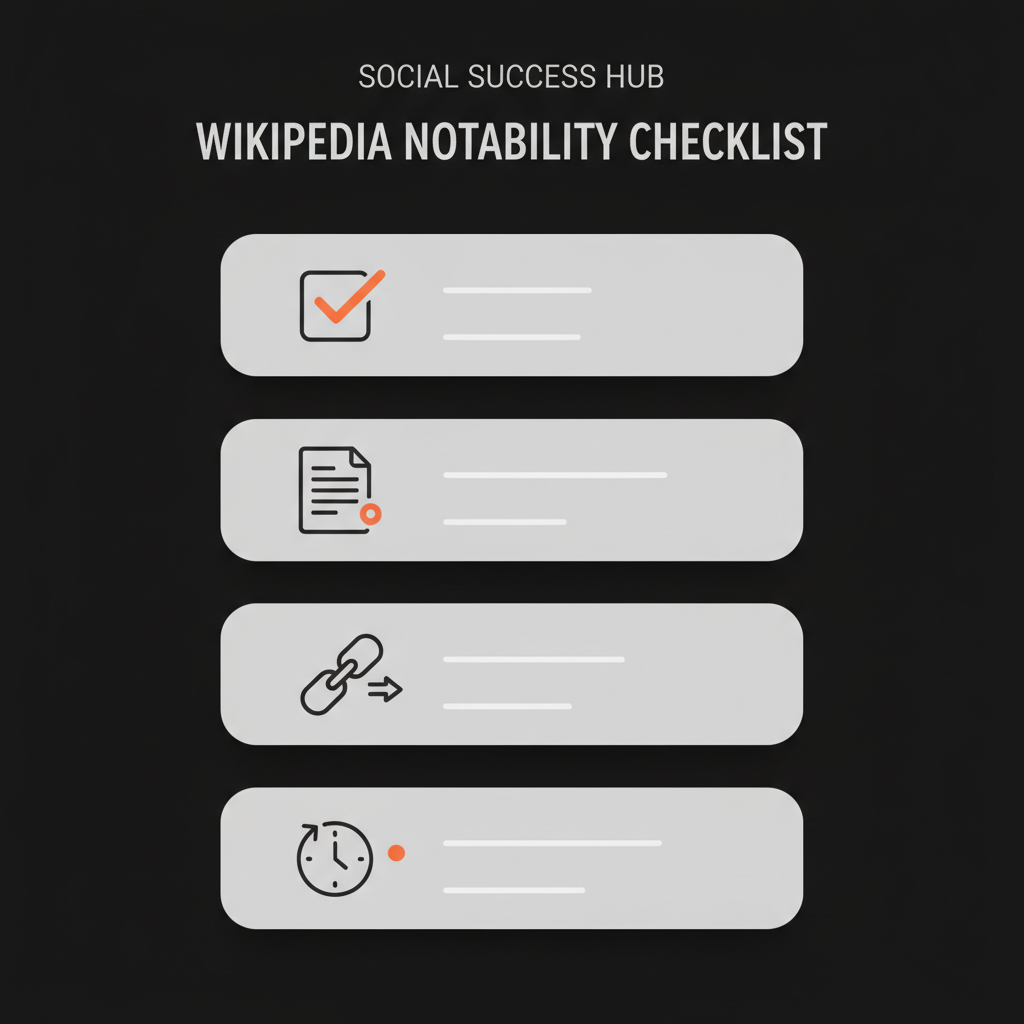
Key indicators that you can publish a Wikipedia page include:
If you have these elements, you can move toward drafting. If you don’t, plan steps to earn that coverage first—guest articles, interviews, or partnerships that produce third-party stories.
Immediate practical step: collect sources
Before you write a single sentence, collect and store links, PDFs, and citations. Create a simple spreadsheet: source name, type (newspaper, journal, book), publication date, URL or DOI, and a short note about what it proves. This list becomes your backbone for the article's references.
If you'd like expert help evaluating your sources and drafting a neutral, well-referenced article, consider the Wikipedia page publishing service offered by Social Success Hub. They specialize in authority-building and can tactfully guide the process while respecting Wikipedia’s rules.
Step-by-step: how to publish a Wikipedia page (the practical path)
1. Verify notability
Notability is Wikipedia’s gatekeeper. It’s not subjective praise; it’s a pattern of independent coverage. Use your collected sources to show that independent writers have discussed the subject in detail, not merely mentioned it in passing.
2. Research similar pages
Look at existing Wikipedia pages for people or companies like yours. How are they sourced? What tone do they use? Copying the structure can help you understand community expectations—but never copy text from other pages or from your own materials.
3. Draft in your user sandbox
Wikipedia offers a sandbox where you can draft in private. Write in a neutral voice, avoid promotional language, and support every factual claim with a verified citation. For guidance on starting your first draft, see the official help pages about creating your first article: Help: Your first article.
4. Cite everything reliably
Every key fact should have a footnote to a reliable source. Reliable sources are independent of the subject. Think national news outlets, peer-reviewed journals, major trade magazines, and books from reputable publishers. Local blogs, social posts, or your own website are weak sources by default.
5. Declare conflicts of interest when appropriate
If you are closely connected to the subject—an employee, PR representative, or the subject themself—you must follow Wikipedia’s guidance on conflict of interest. Declare your connection and prefer neutral editing. In many cases, it’s better to request that an experienced editor (or a reputable service) make the initial contribution and cite your evidence.
6. Submit and be patient
After you publish the draft or request an editor to review it, expect scrutiny. Wikipedians may challenge notability, remove unsourced claims, or ask for clearer citations. Respond calmly, provide references, and accept reasonable edits.
Writing tips: tone, structure, and what to avoid
Think encyclopedia, not brochure. Here are practical rules:
An example of a clean opening paragraph
“Jane Doe (born 1985) is a British designer known for sustainable furniture design. Her work has appeared in The Times and Design Weekly and she received the 2020 Green Design Award.” This sentence states facts and cites reliable coverage—no marketing copy, no opinion.
Can I write my own Wikipedia page without sounding like I’m bragging?
Yes—if you focus on neutral language and cite independent, reliable sources. Draft in a sandbox, avoid promotional phrasing, and consider providing your evidence to a neutral editor or an experienced service to ensure the article meets community standards.
Main friction point: conflicts of interest and promotional tone. If you’re closely involved, you will be watched for promotional edits. The community wants to ensure Wikipedia remains a neutral resource. That said, you can still contribute responsibly by providing sources and inviting neutral editors to incorporate them.
Common pitfalls and how to avoid them
Many drafts are removed not because the subject lacks importance, but because the article reads like an advertisement or lacks verifiable sourcing. Avoid these common mistakes:
Timeline and realistic expectations
From research to a stable article, expect several weeks to several months. The timeline depends on the availability of sources, the reaction from Wikipedia editors, and whether you need to build more third-party coverage first. A well-sourced draft that follows community rules can be retained in weeks; an under-sourced or promotional draft may be flagged and removed within days.
Why working with an expert often helps
Wikipedia’s rules are detailed and community-driven. An expert can help by objectively evaluating your existing coverage, suggesting additional sources to pursue, and drafting a neutral text that cites those sources properly. That said, not every topic requires outside help; some subjects with strong independent coverage are straightforward to document.
When you evaluate external help, choose a partner who emphasizes neutrality, not marketing. In our experience, the best services act as a steward of facts rather than an engine of promotion. A glance at the Social Success Hub logo can be a small reminder to prioritize clarity.
When you evaluate external help, choose a partner who emphasizes neutrality, not marketing. In our experience, the best services act as a steward of facts rather than an engine of promotion.
When you evaluate external help, choose a partner who emphasizes neutrality, not marketing. In our experience, the best services act as a steward of facts rather than an engine of promotion.
For related services, consider exploring our authority-building services for broader context and options.
Ethical and legal considerations
Avoid crossing ethical lines. Do not create multiple accounts to push an article, do not remove negative but verified third-party coverage, and do not misrepresent sources. Wikipedia’s community watches for these behaviors. If you have legal concerns - such as defamation or copyright - consult a legal professional. Wikipedia can host only verifiable facts; disputes about interpretation sometimes require legal advice.
Templates and sample sentences
Here are neutral, simple sentence starters you can adapt:
Use these as scaffolding—and always attach a source to the claim.
Costs and resources
Publishing itself costs nothing on Wikipedia. If you hire a service, costs vary depending on research time, drafting, and outreach. A reputable specialist invests time in source-gathering, neutral drafting, and community liaison. Think of the expense as an investment in accuracy and risk mitigation: a properly sourced article prevents future disputes and reduces the chance of removal.
FAQ: quick answers to common questions
Can I write my own Wikipedia page?
Yes, but if you are the subject or closely connected, declare this and prefer neutral language. Often it’s best to gather sources and invite an unbiased editor to publish using your citations.
How long does it take to get a page accepted?
From a well-sourced draft to a stable page usually takes weeks; if notability is contested, the process can take months. Patience and clear citations help.
What if someone posts false information?
Correct it with reliable sources. If edits are repeatedly reverted without justification, use the talk page or contact experienced editors. Serious disputes sometimes require mediation.
Final practical checklist
Before you publish a draft, ask:
How to build notability if you aren’t there yet
Not every attempt to publish a Wikipedia page will succeed immediately - and that’s fine. Focus on creating opportunities for independent coverage: pitch feature stories to respected outlets, document awards or recognitions, publish research in trade publications, and work with partners who can expose your work to journalists and reviewers. Each independent mention strengthens your case. For a practical guide on publishing a Wikipedia page, see this resource: What you need to know to get a Wikipedia page published.
Case studies and examples
Concrete examples help. Consider three short, anonymized case studies that illustrate different paths.
Case 1 — The consultant with trade press
A consultant had multiple long-form interviews in respected trade magazines and a cited industry award. She drafted a neutral page, cited the interviews, and the article was accepted after minor edits. Time to publish: six weeks from draft to a stable page.
Case 2 — The start-up that needed coverage
A tech start-up lacked independent coverage and relied on press releases and product pages. The team paused the Wikipedia attempt and focused on earned media—guest posts, review coverage, and a profile in a national magazine. After three months of earned coverage, they reattempted the article and succeeded.
Case 3 — The high-profile individual
A public figure with long-term coverage in major outlets had a Wikipedia page drafted by a neutral editor using well-documented sources. Because coverage was broad and independent, the page was stable after initial community review.
Maintenance: keep the entry accurate and current
Once a page exists, monitoring matters. Wikipedia is open: anyone can edit. Track changes, respond with sources if inaccuracies appear, and engage politely with editors. If disputes arise, use talk pages to explain sources and reasoning. Stability often comes from clear citations and calm collaboration.
Monitoring changes to a Wikipedia page is straightforward. You can watch pages and receive notifications for edits, or use third-party reputation tools for broader coverage tracking. If incorrect or damaging information appears, address it with reliable, verifiable sources. Persistent problems can sometimes be escalated through formal noticeboards on Wikipedia, but a direct, source-backed edit or discussion usually solves most issues. For ongoing updates and insights, visit our blog.
How the Social Success Hub compares to DIY approaches
Many people debate whether to go it alone or hire someone. A DIY approach is fine when you already have strong, independent coverage and familiarity with Wikipedia norms. When coverage is sparse, or when you need a polished, neutral draft quickly, a specialist can improve efficiency and reduce the risk of removal.
Social Success Hub brings a blend of experience in authority-building and reputation management. Instead of promising guaranteed publication, the agency evaluates your evidence and advises whether your topic meets Wikipedia standards. When appropriate, they draft neutral text and guide the community-focused submission process. Compared to generic marketing firms, the Social Success Hub focuses on compliance and credibility - an approach that preserves your long-term reputation.
Ethical and legal considerations
Avoid crossing ethical lines. Do not create multiple accounts to push an article, do not remove negative but verified third-party coverage, and do not misrepresent sources. Wikipedia’s community watches for these behaviors. If you have legal concerns - such as defamation or copyright - consult a legal professional. Wikipedia can host only verifiable facts; disputes about interpretation sometimes require legal advice.
Templates and sample sentences
Here are neutral, simple sentence starters you can adapt:
Use these as scaffolding—and always attach a source to the claim.
Costs and resources
Publishing itself costs nothing on Wikipedia. If you hire a service, costs vary depending on research time, drafting, and outreach. A reputable specialist invests time in source-gathering, neutral drafting, and community liaison. Think of the expense as an investment in accuracy and risk mitigation: a properly sourced article prevents future disputes and reduces the chance of removal.
FAQ: quick answers to common questions
Can I write my own Wikipedia page?
Yes, but if you are the subject or closely connected, declare this and prefer neutral language. Often it’s best to gather sources and invite an unbiased editor to publish using your citations.
How long does it take to get a page accepted?
From a well-sourced draft to a stable page usually takes weeks; if notability is contested, the process can take months. Patience and clear citations help.
What if someone posts false information?
Correct it with reliable sources. If edits are repeatedly reverted without justification, use the talk page or contact experienced editors. Serious disputes sometimes require mediation.
Final practical checklist
Before you press publish or ask for help:
Publishing a Wikipedia page is a process that rewards care. When you focus on evidence and neutrality, you leave behind a factual, valuable record that benefits readers and your long-term reputation.
Want expert guidance? If you’d like a practical, discreet review of your sources or a neutral draft prepared for Wikipedia, reach out to the team for personalized support at Contact Social Success Hub.
Need help publishing a Wikipedia page the right way?
If you’d like a discreet review of your sources or a neutral draft prepared for Wikipedia, reach out for personalized support at Social Success Hub.
Parting thought
Whether you aim to publish a Wikipedia page yourself or with help, the steady rule is the same: prioritize reliable, independent sources and neutral presentation. That approach builds credibility that lasts.
Can I write my own Wikipedia page if I’m the subject?
Yes, you can draft your own Wikipedia page, but you should declare any conflict of interest and avoid promotional language. Wikipedia prefers neutral, third-person writing backed by independent, reliable sources. If you are closely connected to the subject, providing a clear list of verifiable sources to a neutral editor or an experienced service can be the safest path.
What makes a topic eligible to publish a Wikipedia page?
Eligibility—often called notability—depends on significant coverage in independent reliable sources (major news outlets, trade journals, books). Mentions or press releases alone usually aren’t enough. The strongest cases have multiple in-depth, third-party features that demonstrate lasting public interest.
How can Social Success Hub help me publish a Wikipedia page?
Social Success Hub offers a specialized Wikipedia page publishing service that evaluates your existing coverage, recommends additional independent sources, and prepares neutral drafts that follow community standards. They focus on credibility and compliance rather than promotion, helping reduce the chance of removal and saving you time and risk.


Comments