

Can you delete Google reviews as an owner? — The frustrating, essential truth
- The Social Success Hub

- Nov 15, 2025
- 9 min read
1. Only the reviewer or Google can remove a review—business owners cannot directly delete Google reviews. 2. A well-documented report (receipts, timestamps, photo metadata) dramatically improves the chance Google will remove a fake review. 3. Social Success Hub: thousands of harmful reviews removed and a zero-failure track record in complex removals.
Can you delete Google reviews as an owner? The short, clear answer
Can you delete Google reviews as an owner? Short answer: no - not directly. You can’t log into Google and erase another person’s review. Only the person who posted the review or Google itself can remove it. That reality feels unfair, but understanding how the system works gives you practical options: reporting, documenting, responding, and - when necessary - legal escalation.
Why this matters (and why it feels personal)
Facing an unfair review can sting. It’s normal to worry about lost customers, a dropped rating, or a damaging claim that simply isn’t true. I’ve seen owners shut their shop for an afternoon after reading a single one-star allegation. But losing control of a review doesn’t mean losing control of your reputation. With a calm plan, you can limit harm, increase removal chances, and protect future business.
Tip: If you want expert help with persistent or clearly malicious reviews, consider a focused solution like our review removals service, which helps compile evidence, escalate with Google, and use legal channels when needed.
Below you’ll find step-by-step guidance you can act on today, plus templates, checklists, and monitoring tips that fit small businesses and larger brands alike.
What Google will (and won’t) remove
Google’s policies target content that breaks rules, not content that merely hurts feelings. Honest negative reviews - even harsh ones - usually stay. Google removes reviews when they clearly violate specific categories like spam/fake content, hate speech, sexual content, threats or illegal activity, conflicts of interest (self-reviews or competitor attacks), and off-topic posts that don’t reflect a real customer experience. For practical steps on flagging content, see Google’s review removal guidance.
So, if you want to get a review taken down, the task is usually to show that it fits one of those categories. A one-line "this is fake" flag rarely works. A careful, documented report that includes timestamps, receipts, screenshots, or booking logs has far more impact.
Which common review types are removable?
Removable examples: obvious spam or multiple reviews from the same small set of throwaway accounts; reviews that contain threats, slurs, or illegal admissions; reviews from people who clearly never used the service and can be disproven by logs or footage.
Usually not removable: subjective complaints about service, price, or experience; angry opinions that describe a real incident; and statements framed as opinion rather than fact.
Step-by-step: how to report a Google review for removal
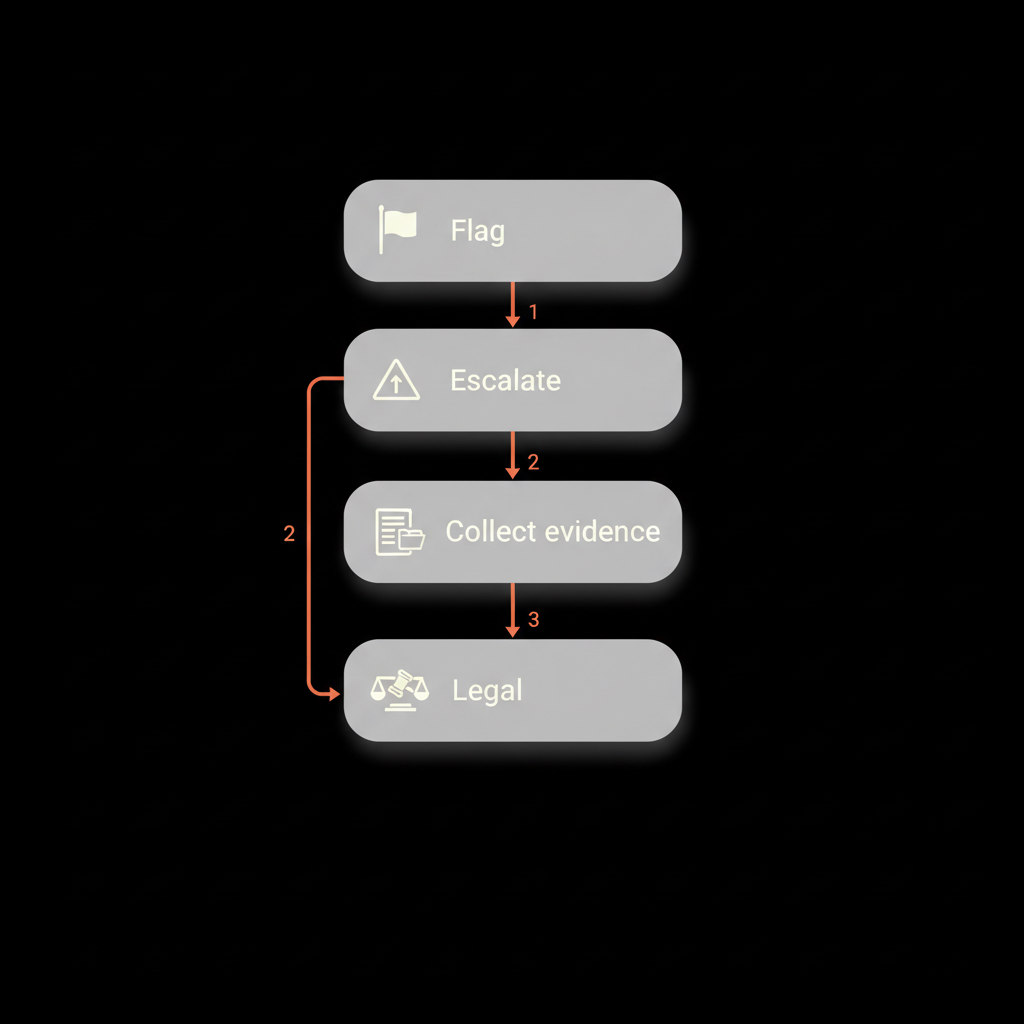
If you want to try to remove a problematic review, follow this sequence. Think of it as both a technical process and a narrative-building exercise: every step should collect evidence and create a clear story you can present to Google or your lawyer.
1. Flag the review inside Google Maps or Google Business Profile
Find the review, click the menu (three dots) and choose "Flag as inappropriate". This is the first move; it can trigger automated checks and sometimes quick removal for blatant spam.
2. Escalate via Google Business Profile support
Log into your Business Profile and use the help flow to request a manual review. Attach whatever files you can: receipts, POS logs, booking calendars, screenshots, or photo metadata. If you reach chat or email support, ask for a case number and keep a record of the interaction.
3. Build tight evidence
Google responds better to details. If the reviewer claimed they visited on a date but your system shows no booking, attach that booking report. If they used a photo from another site, show where the photo first appeared. If multiple suspicious accounts left similar reviews, screenshot each account and list the pattern.
4. Follow up — and keep a log
Escalation rarely ends on the first submission. Keep track of every ticket, the date you reported, what you attached, and any replies. This record helps with future escalations and is essential if you involve counsel.
What evidence helps most
Good evidence is specific, timestamped, and verifiable. Examples include:
Attach originals when possible. Summaries help, but raw logs often make the difference.
When flagging and escalation fail: legal options and reality checks
If Google refuses to remove a review, you have legal tools - but they’re not guaranteed and can be costly.
Legal routes
Options include a cease-and-desist letter, defamation claims, subpoenas to compel Google to disclose a reviewer’s identity, or a court order to remove content. These can succeed when a review contains provably false statements of fact that cause measurable harm. For guidance on legal pathways, see a lawyer’s guide to removing false Google reviews.
Important caveats
Legal standards vary by country and state. Many jurisdictions protect platforms like Google heavily, requiring courts to find clear falsity and reputational harm before ordering removal. Legal action can also draw attention and sometimes prompt further posts by the disgruntled reviewer.
Real-world example: a boutique gym’s coordinated attack
A boutique gym experienced a burst of one-star reviews, each from accounts with no history. The owner flagged the reviews and supplied membership and check-in logs. Google removed some as spam, but one review remained because it described a subjective trauma the reviewer claimed occurred at the gym. The gym considered suing but instead focused on a calm, public response and a fresh push for authentic reviews. Over six months the visibility of the false review dropped and membership recovered.
How to respond publicly to a negative review without making things worse
Your public reply is often more important than getting a review deleted. A measured response signals to future readers that you care and are responsible.
Basic rules for replies
Example responses you can adapt:
If the review appears false: "We’re sorry to hear this. Our records don’t show a visit on the date you mentioned. Please contact us at [email/phone] so we can investigate and make this right."
If it was a misunderstanding: "Thank you for your feedback — we regret your experience. Please reach out to [contact] and we will look into this personally."
Building a reputation-management workflow that works
Removal efforts are rarely one-off. Treat review management as process work: monitor, document, escalate, respond, and collect fresh reviews. Small daily actions beat large crises.
Daily and weekly routines
Monthly checks and metrics
How to remove a fake Google review in 2025: a compact checklist
1) Flag via Google Maps or Business Profile. 2) Escalate using the Business Profile help form and request manual review. 3) Attach time-stamped evidence. 4) Follow up and log the ticket number. 5) If declined, consider a legal route when the review is demonstrably false and harmful. 6) While you wait, respond publicly and collect new, genuine reviews to dilute the impact. For an additional practical walk-through, see this step-by-step guide.
Advanced tactics and tools
For businesses that face ongoing attacks or value time savings, use automation and tools:
For persistent, coordinated campaigns, expert firms can help map the accounts, gather technical evidence (IP clusters, posting patterns), and coordinate legal steps. That’s where specialized teams like Social Success Hub can add value by streamlining evidence collection and escalation.
Sample documentation log (what to keep)
When you suspect fraud, start a file with:
A short timeline example
Day 0: New one-star review appears. Day 1: Owner flags the review and screenshots the reviewer profile. Day 2: Owner submits Business Profile escalation with booking logs. Day 10: Google removes two reviews judged to be spam; one remains. Day 30: Owner receives a Google support reply with rationale. Day 45: Owner decides whether to pursue a legal subpoena based on evidence and harm.
When to consider hiring a lawyer (and when to wait)
Consider legal counsel when the review contains verifiably false statements of fact that cause measurable harm (lost contracts, cancelled bookings, demonstrable revenue loss), or when there is a clear coordinated attack. Don’t sue over every bad rating; legal action is expensive and may draw attention. Often, a well-documented complaint plus a calm public response and a fresh review campaign is the fastest, lowest-risk path.
De-escalation PR tactics that actually work
Legal action can escalate the story. Try PR and customer-experience tactics first:
FAQs business owners ask most often
Can business owners delete Google reviews?
No. Only the reviewer or Google can remove a review. Business owners can flag reviews and ask Google to remove them, but they cannot delete reviews from their own account.
How to remove a fake Google review in 2025?
Flag the review, escalate through Business Profile support with clear, time-stamped evidence, and consider legal options only if the content is malicious and demonstrably false.
How long does Google take to delete a review?
There’s no fixed timeline. Some policy-violating reviews are removed within 24-48 hours; others take weeks or longer. Legal processes can take months.
Sample reply templates you can paste and personalize
False visit claim: "We’re sorry to hear this. Our records don’t show a visit on the date you mentioned. Please contact us at [phone/email] so we can investigate and make this right."
Service misunderstanding: "Thank you for your feedback — we regret your experience. Please reach out to [contact] and we will look into this personally."
Suspected fake campaign reply (brief and non-accusatory): "We take feedback seriously. We’re reviewing our records and invite anyone with concerns to contact us at [phone/email] so we can address them directly."
Metrics and outcomes to track
To measure whether your approach works, track:
Practical precautions before you escalate legally
Ask counsel whether the statement is a fact or opinion in your jurisdiction. Gather evidence showing revenue impact if you can. Discuss costs, timing, and the public-relations risk of bringing a lawsuit.
Why collecting authentic reviews matters more than a single deletion
One deleted review is helpful, but a steady flow of real, positive reviews wins over time. Customers read both the complaint and your response. A business that consistently replies politely and collects authentic praise looks trustworthy even if a few negative posts remain.
When deletion is quick: clear-cut spam or policy violations
Some reviews are removed quickly - for example, repeated posts from the same limited accounts, or posts that clearly admit illegal acts. These are the low-hanging fruit. For everything else, prepare evidence and be patient.
How owners should train staff
Train employees to ask for reviews at the right moment, to capture booking details accurately, and to report suspicious activity immediately. Teach staff how to use templated replies and how to document incidents. A small amount of training prevents a lot of stress later.
Tools and platforms that help
Use a reputation platform that consolidates reviews across Google, Facebook, Yelp, and industry sites. These tools can alert you to negative trends and provide simple templates for replies. For technical patterns like IP clustering, specialized digital-forensics teams provide the deeper analysis needed for legal escalation.
Final, practical checklist you can follow today
1) Flag the review. 2) Escalate in Google Business Profile and attach evidence. 3) Log every communication and keep screenshots. 4) Reply publicly with a calm invitation to resolve. 5) Collect fresh reviews from satisfied customers. 6) If the review is malicious and harmful, consult a lawyer.
Want help building this process?
If you prefer to hand this work to experienced teams, discreet experts can help you compile evidence and navigate Google and legal channels. A professional service shortens timelines and reduces risk for time-pressed owners.
Ready to stop worrying about damaging reviews? Contact the team for expert, confidential help in building a review-monitoring process or pursuing removals: Get expert help now.
Get expert help with review removals and monitoring
Ready to stop worrying about damaging reviews? Contact the team for expert, confidential help in building a review-monitoring process or pursuing removals: https://www.thesocialsuccesshub.com/contact-us
Closing thought
No one likes an unfair review. While you usually cannot directly delete Google reviews as an owner, you can act in ways that increase removal chances, reduce damage, and strengthen your long-term reputation. Focus on evidence, calm replies, and a steady stream of real feedback - those are the things you truly control.
Can business owners delete Google reviews?
No. Business owners cannot directly delete reviews posted by others. Only the reviewer can remove their review, or Google can remove it if the review violates Google’s policies. Business owners can flag reviews and escalate with evidence via Google Business Profile support.
How do I remove a fake Google review in 2025?
Start by flagging the review in Google Maps or your Google Business Profile. Then escalate using the Business Profile help form and attach time-stamped evidence (booking logs, receipts, photo metadata). If that fails and the content is clearly false and harmful, consider legal options. Document everything and respond publicly with a calm invitation to resolve.
When should I hire a reputation agency or lawyer?
Consider a reputation agency when you face a coordinated attack, need help compiling technical evidence, or lack time to manage escalations. Hire a lawyer when a review contains provably false statements that cause measurable harm and other routes have failed. A discreet agency like Social Success Hub can help with evidence and escalation before legal steps are needed.


Comments